
Production Planning Software Is Only as Useful as the Data Behind It
Your manufacturing operation has accumulated years of valuable knowledge in engineering files, BOMs, spreadsheets, work instructions, paper records, and legacy applications. That information can be the starting point for a more connected, data-driven operation.
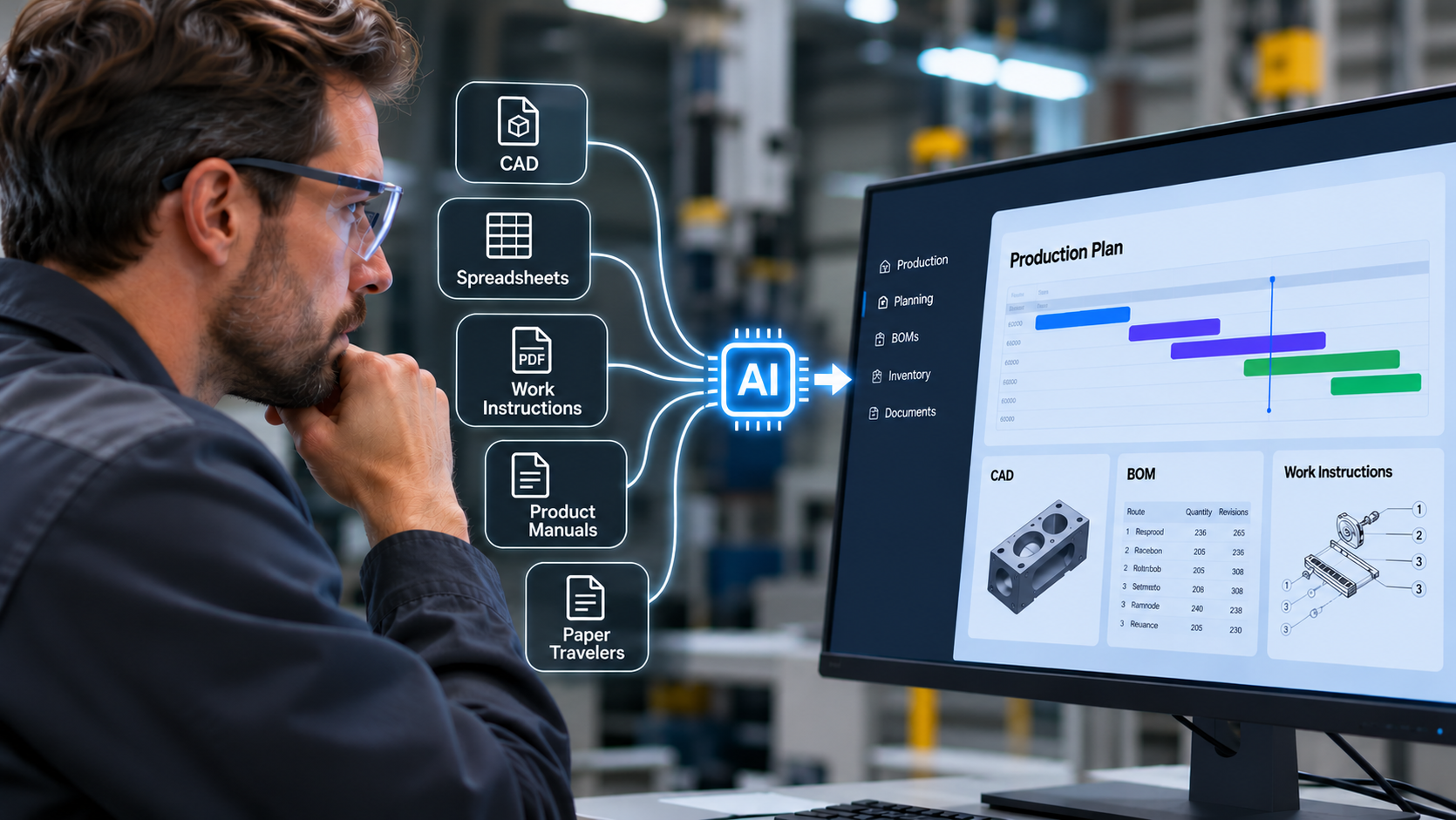
Production planning depends on understanding what needs to be made, which materials are available, what resources are required, and when production can take place. When this information is scattered across spreadsheets, engineering files, paper records, and disconnected applications, planners often spend more time gathering information than using it to make decisions.
Modern production planning software can help bring those inputs together, but the transition starts with identifying and organizing the underlying data. Once validated and connected, this information can support:
- More informed material planning: Connect product structures and material requirements with inventory and purchasing information.
- Better production visibility: Bring demand and production requirements into connected workflows instead of relying on disconnected spreadsheets.
- More consistent operational processes: Make relevant instructions and product information accessible where they are needed.
- A stronger foundation for AI-assisted planning: Give intelligent workflows the operational context needed to analyze requirements and assist with decisions.
This doesn’t mean that uploading a folder of documents automatically produces an optimized production schedule. Effective planning still depends on accurate data, defined processes, available capacity information, and appropriate system configuration. It does mean that manufacturers can begin building those capabilities using information they already possess.
AI in Manufacturing Starts With the Data You Already Have
AI in manufacturing is often discussed in terms of predictive analytics, autonomous planning, and intelligent automation. But those capabilities depend on access to relevant operational information.
AI cannot reliably optimize what it cannot see. If product structures are disconnected from material availability, or production requirements are buried in spreadsheets and documents, it becomes harder to automate decisions across the operation.
A modern manufacturing system creates an opportunity to bring those information sources together. Once relevant data is extracted, structured, and connected, it can support more informed production planning, better operational visibility, and AI-assisted workflows.
Consider a few examples:
- More informed production planning. Structured BOMs, order requirements, and inventory information help production planning software determine what needs to be produced and what materials may be required.
- Reduced manual data handling. Automating the transfer of information from supported documents and systems can reduce repetitive entry and the administrative work associated with maintaining disconnected records.
- Better access to manufacturing knowledge. Organizing technical documentation and work instructions can make information easier to locate and use in the right operational context.
- A stronger foundation for AI automation. Connected product, material, and production data gives AI-enabled workflows better context for analyzing requirements, identifying issues, and assisting with operational decisions.
These outcomes don’t happen simply because a manufacturer uploads a folder of files. The data must be extracted appropriately, mapped to the right records, checked for accuracy, and integrated into meaningful workflows.
But that work is achievable. And it doesn’t require every piece of information to have been stored in a modern database from day one.
What If Your Data Is Already in a Legacy ERP?
Not every manufacturer is starting from spreadsheets and paper records. Many have invested years in legacy manufacturing software, including systems that have become difficult to maintain or no longer support their operational needs.
In these cases, the concern is different: migrating years of historical and operational data into a modern platform can seem like a major undertaking. That’s why StartProto uses AI-powered migration agents designed to help move data from legacy manufacturing systems into StartProto.
AI Migration Agents Reduce the Burden of Legacy Transitions
Legacy system migrations often involve repetitive, time-consuming work: extracting records, mapping fields, reconciling differences in data structures, and preparing information for import into a new environment.
AI-powered migration agents can assist with this process by analyzing available source data, helping map legacy structures to the target system, and accelerating migration workflows.
StartProto’s AI Migration Agents address one of the practical obstacles to replacing legacy manufacturing software. Rather than treating migration as an entirely manual data-conversion exercise, AI-assisted tooling can help reduce the effort required to interpret and transfer legacy information.
As with any migration, the process still requires appropriate validation. The goal is to make migration more efficient while maintaining the accuracy and integrity of critical manufacturing records. For manufacturers considering a change, that can make the path forward more manageable.
You Don’t Need Perfect Data to Modernize Your Manufacturing Operation
There will always be work involved in moving to a new manufacturing ERP system. Product records may need cleanup. Duplicate entries may need to be resolved. Historical data may require special treatment. Some information may be missing, outdated, or stored in formats that require additional processing.
Those are implementation challenges—not automatic reasons to postpone modernization.
The more important questions are:
- Where does your operational data currently live?
- Which information is essential to running and planning production?
- What can be extracted, imported, or transformed?
- What needs to be validated by your team?
- How can connected data support better manufacturing decisions over time?
Answering those questions is the beginning of a practical data strategy.
And when your implementation partner is equipped to investigate existing data sources, extract useful information, and support legacy migration, you don’t have to solve everything on your own before getting started.
Conclusion
StartProto Helps You Move Forward With the Data You Have
Your manufacturing operation has accumulated years of valuable knowledge in engineering files, BOMs, spreadsheets, work instructions, paper records, and legacy applications. That information can be the starting point for a more connected, data-driven operation.
StartProto combines manufacturing ERP software with a forward-deployed engineering approach designed to uncover operational data during onboarding and implementation. AI-assisted data extraction and migration capabilities help bridge the gap between how your operation works today and the connected workflows you want to build tomorrow.
You don’t need to wait until every record is digitized, every spreadsheet is standardized, or every legacy system has been perfectly maintained.
You need a practical path from the data you have to the manufacturing operation you want.
Ready to explore what that path looks like for your business?
Book a demo and discover how modern manufacturing ERP software can help you connect your data, improve production planning, and build a foundation for AI in manufacturing.

Unlock the potential of AI manufacturing
Blogs & Resources
Industry trends, manufacturing business tips, and more

Ready to get started?
We'll make it easy for you — pick the time that works best for you and we'll send an invite right to your calendar.