
Why Manufacturing Job Profitability Changes Long Before a Job Is Complete
For manufacturers, profitability isn't a number that should only be evaluated after an order ships and the books are closed. It evolves throughout quoting, purchasing, production, and fulfillment. The more accurately manufacturers capture actual costs and compare them with estimates, the better equipped they are to identify margin erosion, improve future quotes, and make informed operational decisions.
When a manufacturer quotes a job, profitability is typically based on estimated material costs, labor hours, machine time, outside processing, and overhead. These estimates help determine pricing and establish the expected margin.
But estimates are only the starting point. As production progresses, actual costs begin to replace assumptions. Materials may cost more than anticipated. Labor hours can exceed estimates. Scrap, rework, production delays, and outside processing can introduce expenses that weren't included in the original quote. By the time a job is complete, the actual margin may look very different from the expected margin.
This creates a fundamental challenge in manufacturing job costing: knowing whether a job is profitable after it's finished isn't the same as knowing whether it's still profitable while it's in production. For manufacturers, that distinction can have a significant impact on financial performance.
The Gap Between Estimated and Actual Job Costs
Manufacturing job costing starts with an estimate of the resources required to complete an order.
Depending on the complexity of the work, this may include:
- Raw materials and purchased components
- Direct labor
- Machine and production time
- Outside processing
- Tooling and consumables
- Allocated manufacturing overhead
These estimates help establish the expected cost of production and determine the price quoted to the customer. However, actual production rarely follows the original estimate perfectly.
A supplier may increase material prices. An employee may need additional time to complete an operation. A component may fail inspection and require replacement. Outside processing may take longer or cost more than expected.
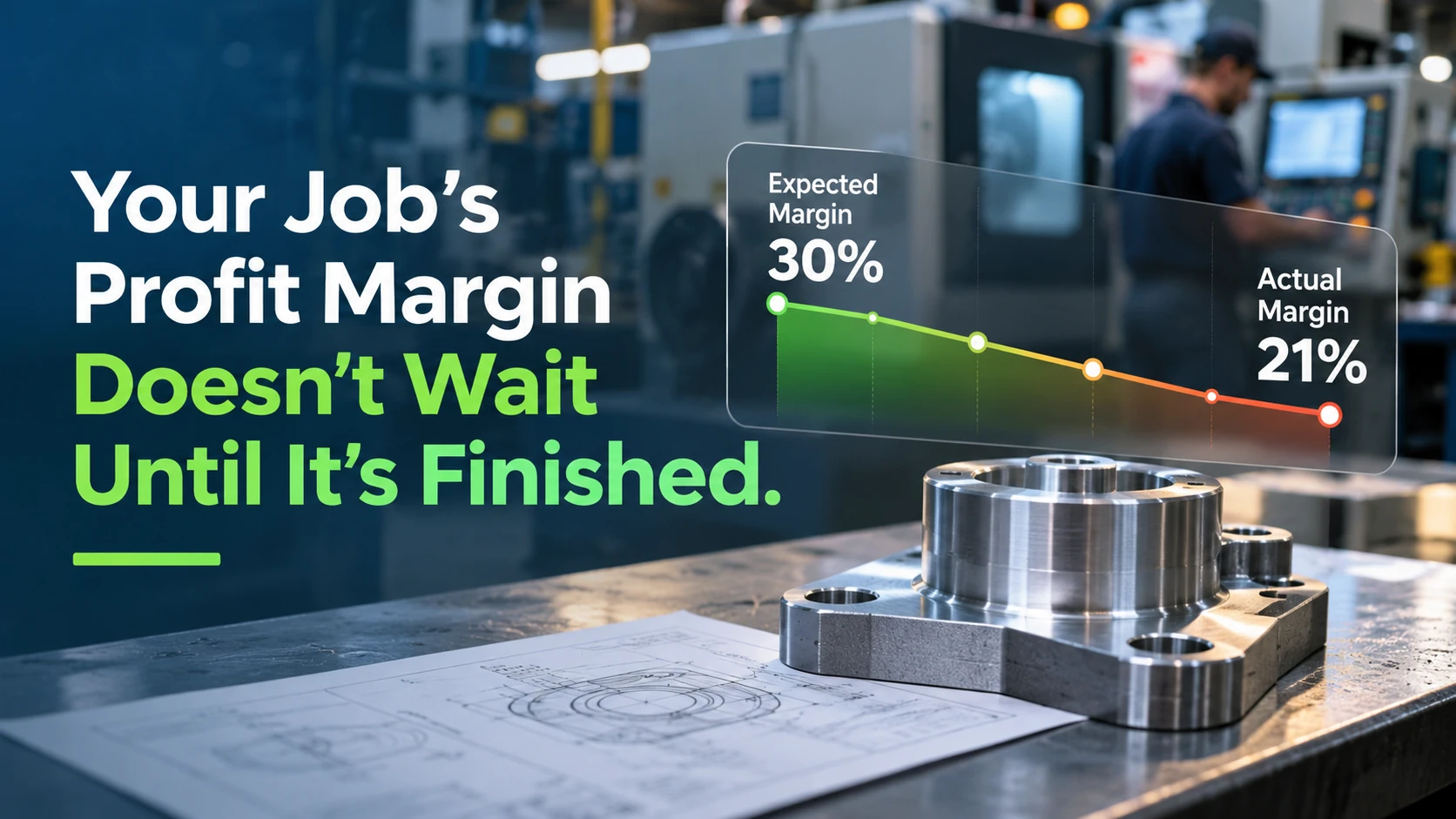
Each variance affects the actual cost of the job. For example, consider a manufacturer that quotes a customer $50,000 for an order with an estimated production cost of $35,000. The expected gross margin is $15,000, or 30%.
During production, however, the manufacturer experiences:
- $2,000 in additional material costs
- $1,500 in unplanned labor
- $1,000 in additional outside processing
The actual production cost increases to $39,500, reducing gross margin to $10,500, or 21%.
The manufacturer still makes money on the order, but the margin has declined by nine percentage points. If this happens across multiple jobs, the cumulative impact on profitability can be substantial.
Why Accounting After the Fact Isn't Enough
Traditional accounting processes are designed to capture and organize financial transactions. They provide the foundation for accurate financial statements, reporting, and compliance. But manufacturing job profitability is influenced by operational activity that occurs throughout production. A material issue, labor entry, subcontracting transaction, or scrap event may change the cost of a job before the corresponding financial reporting cycle is complete.
When production and accounting systems aren't closely connected, finance teams may not see the financial impact until costs are reconciled or jobs are closed. By then, the opportunity to correct the problem may have passed. A manufacturer that discovers a job exceeded its labor estimate after completion can't recover those hours. A purchasing manager who identifies a material cost increase after production has already started may have limited options to protect the margin.
The value of job costing isn't just in measuring profitability. It's in identifying cost variances early enough to make better decisions.
The Importance of Tracking Costs Throughout Production
Accurate manufacturing job costing requires capturing costs as they occur and associating them with the appropriate job. This includes more than direct material and labor expenses.
Manufacturers need to account for:
- Material consumption: Actual materials issued to a job may differ from the original bill of materials or estimate.
- Labor costs: Actual production hours may exceed planned hours because of complexity, training, equipment issues, or rework.
- Outside processing: Subcontracted operations can introduce additional costs, especially when supplier pricing or quantities change.
- Scrap and rework: Defective materials and repeated operations increase the cost of completing a job.
- Overhead: Production resources, facility expenses, equipment depreciation, and indirect labor must be accounted for appropriately.
When these costs are tracked in isolation, it becomes difficult to understand the true financial performance of an individual job. Connecting production activity with job costing provides a more complete picture.
Overhead Allocation Can Distort Profitability
Another challenge in manufacturing cost accounting is determining how to allocate overhead. Manufacturers have expenses that support production but aren't always directly attributable to a specific job.
Examples include:
- Facility expenses
- Equipment depreciation
- Utilities
- Maintenance
- Indirect labor
- Production supervision
- Quality management
These costs need to be allocated across production activity using an appropriate methodology. However, allocation methods can create misleading profitability figures if they don't accurately reflect how resources are consumed. For example, allocating overhead strictly by direct labor hours may not accurately represent the cost of a job that requires significant machine time but relatively little direct labor.
Manufacturers need costing methodologies that reflect their actual production environment and provide meaningful information for pricing and profitability decisions.
Understanding Job Profitability Before Production Ends
The most useful job costing information isn't limited to historical reporting. Manufacturers benefit from understanding how costs are accumulating relative to the original estimate.
This allows them to identify:
- Jobs where material consumption is exceeding expectations
- Production operations requiring more labor than planned
- Outside processing costs that are increasing
- Jobs experiencing excessive scrap or rework
- Orders where expected margins are deteriorating
This information can inform decisions while production is still underway. For example, a manufacturer may identify that a particular operation consistently requires more labor than originally estimated. That insight can influence future quoting, production planning, and resource allocation.
Over time, better job costing can improve both operational efficiency and pricing accuracy.
Connecting Job Costing With Financial Management
Job costing shouldn't operate independently from the rest of a manufacturer's financial processes. Job costs influence inventory valuation, WIP, accounts payable, customer invoicing, and financial reporting.
A supplier invoice for outside processing should be connected to the relevant job. Material purchases should be traceable to inventory and production demand. Labor and production costs should contribute to understanding the actual cost of completing an order.
When these activities are disconnected, manufacturers spend time reconciling information rather than analyzing it. A manufacturing ERP system that connects operational activity with accounting and financial management can provide greater visibility into how costs accumulate and how jobs contribute to overall profitability.
Conclusion
Profitability Should Be Measured Throughout the Job Lifecycle
For manufacturers, profitability isn't a number that should only be evaluated after an order ships and the books are closed. It evolves throughout quoting, purchasing, production, and fulfillment.
The more accurately manufacturers capture actual costs and compare them with estimates, the better equipped they are to identify margin erosion, improve future quotes, and make informed operational decisions.
The goal of manufacturing job costing isn't simply to understand what a job costs. It's to understand why it cost what it did, how that affects profitability, and what can be done differently on the next job.
StartProto brings production, purchasing, inventory, and job costing together to help manufacturers build a more complete understanding of operational costs and financial performance. Book your demo.

Unlock the potential of AI manufacturing
Blogs & Resources
Industry trends, manufacturing business tips, and more

Ready to get started?
We'll make it easy for you — pick the time that works best for you and we'll send an invite right to your calendar.