

Manufacturers depend on accurate inventory data, efficient production planning, and coordinated warehouse operations to maintain profitability and meet customer expectations.
Yet many manufacturing organizations still operate disconnected systems for ERP, inventory management, warehousing, purchasing, and production.
These disconnected environments create operational inefficiencies that slow decision-making, reduce inventory accuracy, and increase administrative overhead.
As manufacturing operations become more complex, integrated warehouse management and cloud manufacturing software are becoming essential for operational scalability.
The Problem with Disconnected Systems
Disconnected systems create data silos across manufacturing operations.
When warehouse management software does not communicate effectively with ERP systems, manufacturers often experience:
- Delayed inventory updates
- Duplicate data entry
- Inaccurate stock counts
- Purchasing mistakes
- Production scheduling issues
- Poor traceability
- Limited operational visibility
Warehouse teams, purchasing departments, and production planners may all work from different information.
This creates confusion and slows operational responsiveness.
How Disconnected Systems Affect Production
Production teams depend on accurate inventory availability.
When ERP and warehouse systems are not synchronized in real time, manufacturers risk:
- Material shortages
- Production delays
- Excess inventory purchasing
- Missed delivery timelines
Even small inventory discrepancies can create significant downstream operational issues.
Integrated warehouse management helps manufacturers maintain accurate inventory visibility across warehouse and production workflows.
Purchasing Inefficiencies Created by Poor Integration
Purchasing teams rely heavily on inventory data when planning material procurement.
Disconnected systems often create situations where inventory records are outdated or inaccurate.
This may result in:
- Duplicate purchasing
- Excess inventory carrying costs
- Material shortages
- Emergency procurement expenses
Cloud manufacturing software helps eliminate these problems by centralizing operational data across departments.
Warehouse Operations Become Less Efficient
Warehouse teams often suffer the most from disconnected systems.
Without integrated warehouse management, warehouse personnel may rely on:
- Manual inventory updates
- Spreadsheet tracking
- Paper-based workflows
- Delayed ERP synchronization
This reduces warehouse productivity while increasing the likelihood of inventory errors.
Location-based warehousing and real-time inventory visibility help manufacturers improve warehouse organization and operational accuracy.
Traceability Becomes More Difficult
Disconnected systems make traceability significantly harder.
Manufacturers may struggle to connect:
- Material records
- Warehouse movement
- Production history
- Shipping data
- Quality documentation
This creates major challenges during:
- Audits
- Product recalls
- Quality investigations
- Compliance reporting
Integrated cloud manufacturing software helps manufacturers maintain centralized traceability records across operations.
Why Manufacturers Are Moving to Cloud Manufacturing Software
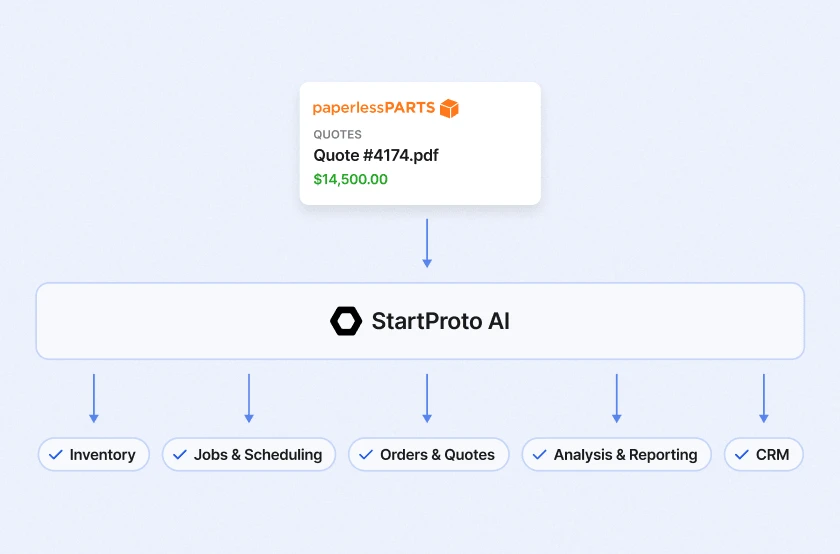
Modern cloud manufacturing software connects ERP, warehouse management software, production workflows, inventory control, and traceability into a single operational platform.
This unified approach gives manufacturers:
- Real-time inventory visibility
- Better operational coordination
- Improved warehouse efficiency
- Stronger traceability
- Faster decision-making
- Reduced administrative overhead
Cloud-based ERP software for manufacturers also provides scalability for growing operations.
Manufacturers can expand facilities, warehouses, and production capacity without creating additional disconnected infrastructure.
AI Manufacturing Software Is Increasing the Need for Unified Data
AI manufacturing software depends on accurate operational data.
Disconnected systems limit the effectiveness of AI-driven insights because operational information remains fragmented across multiple platforms.
Integrated manufacturing platforms provide the centralized data environment needed to support:
- Predictive inventory planning
- Automated replenishment
- Production forecasting
- Warehouse optimization
- Inventory anomaly detection
As manufacturers increasingly adopt AI-driven operational tools, unified systems will become even more important.
The Future Is Integrated Manufacturing Operations
Manufacturers no longer benefit from disconnected operational infrastructure.
The future of manufacturing depends on connected systems that unify:
- ERP software for manufacturers
- Warehouse management software
- Inventory management
- Production workflows
- Traceability
- AI operational insights
Integrated warehouse management helps manufacturers improve visibility, reduce operational friction, and support long-term scalability.
Conclusion
Disconnected ERP and warehouse systems create inefficiencies that modern manufacturers can no longer afford.
Cloud manufacturing software with integrated warehouse management gives manufacturers the visibility and operational control needed to improve productivity, strengthen traceability, and reduce inventory-related issues.
Manufacturers that modernize their operational infrastructure today will be better prepared for the increasing complexity of tomorrow’s manufacturing environment.
Ready to unify your manufacturing operations? Schedule a demo with StartProto to see how integrated warehouse management and cloud manufacturing software can improve operational efficiency.

Unlock the potential of AI manufacturing
Blogs & Resources
Industry trends, manufacturing business tips, and more

Ready to get started?
We'll make it easy for you — pick the time that works best for you and we'll send an invite right to your calendar.