
On February 20th, the Supreme Court struck down tariffs imposed under the International Emergency Economic Powers Act. The next day, a new 10% global surcharge took effect under Section 122. If you're reading this a week from now, there's a decent chance the numbers have changed again.
If you're keeping score at home, tariff rates have changed four or more times in the last twelve months.
Here's what I think the entire tariff debate gets wrong: it focuses on the rates—what percentage, which countries, how long they'll last. And while pundits and politicians argue about that, manufacturers are left trying to run businesses on shifting sand.
I'm not here to take a political side. I'm here to talk about operational reality. And the reality is this: regardless of where tariff rates land next month or next year, the strategic case for domestic manufacturing has never been stronger.
The Tariff Whiplash Problem
You can't build a supply chain strategy around a number that changes every quarter. That's not planning — that's gambling.
And yet that's exactly what companies have been forced to do. Tariff rates have swung wildly — up, down, exempted, re-imposed — all within twelve months. If you built your sourcing strategy around a specific tariff rate, you've already been wrong multiple times.
The companies I talk to every day aren't waiting for Washington to settle this. They're moving. According to a recent Medius survey, 69% of US manufacturers have already begun reshoring production. That's not a prediction — that's a structural shift already underway.
The Reshoring Initiative's 2024 Annual Report backs this up: reshoring and foreign direct investment announcements hit record levels, with 244,000 jobs announced. Manufacturing construction spending is up 40%. These aren't speculative bets — they're capital commitments.
The winners aren't the ones who guessed the right tariff rate. They're the ones who built supply chains that don't depend on tariff policy at all.
The Real Advantages Are Structural
Let's talk about why domestic manufacturing actually wins — and it has nothing to do with tariffs.
Supply chain control. Companies that have reshored report 30–50% reductions in disruption costs. When your supplier is in the same time zone — or the same state — you eliminate an entire category of risk. No more container ships stuck in ports. No more 90-day lead times that turn into 120.
Lead time compression. Weeks versus months. That's not a minor efficiency gain — that's a fundamentally different way to run a business. You can respond to demand changes in real time instead of placing bets three months out.
IP protection. If you're in defense, aerospace, or any regulated industry, compliance matters — ITAR, CMMC, FedRAMP. Try maintaining that with a supply chain that runs through three countries. Domestic manufacturing isn't just easier for compliance — in many cases, it's required.
Quality control. You can walk the floor. You can see the parts coming off the machine. You're not waiting six weeks for a container to arrive only to find out 15% of the parts don't meet spec.
And here's the stat that should end the debate: 94% of manufacturers who have reshored report successful implementation. This works. The data is clear.
"But It's More Expensive to Make in the US"
I hear this all the time. And I get it — it used to be true. For a lot of categories, it still looks true if you only compare unit price on a quote sheet.
But that quote sheet is lying to you.
Many of our customers at StartProto have been able to meet or beat overseas pricing. Not because of subsidies or tariffs — because they invested in the right automation and software to drive efficiency. That's the real story.
When you factor in the real total cost of ownership — freight, quality rejects, inventory carrying costs, lead time buffers, IP risk, and yes, tariff uncertainty — the math changes dramatically. That 30% unit cost advantage from overseas? It's often single digits. Sometimes it's negative.
The hidden costs of offshoring are enormous. That 30% unit cost savings evaporates fast when you're air-freighting rejected parts, carrying three months of safety stock, and spending weeks chasing quality issues across twelve time zones.
Meanwhile, manufacturers who combine reshoring with Industry 4.0 technology are seeing 15–30% labor productivity gains. That's not a theoretical projection — that's what's happening on shop floors right now.
What the Right Automation Actually Looks Like
When people hear "automation," they think robots. And sure, robots are part of it. But the real unlock isn't on the machine — it's in the software layer that ties everything together.
Real-time demand planning eliminates waste and overproduction. Instead of building to a forecast that's already wrong, you're responding to actual demand signals. That alone can cut material waste by 20% or more.
Digital shop floors replace paper travelers and manual tracking. Every job, every operation, every quality check — tracked in real time. That's not just efficiency — that's traceability. And traceability is what wins defense contracts.
AI-powered scheduling optimizes machine utilization. Most shops I visit are running at 60–70% capacity — not because they don't have demand, but because they don't have visibility. Fix the visibility problem, and you unlock 30–40% more capacity without buying a single new machine.
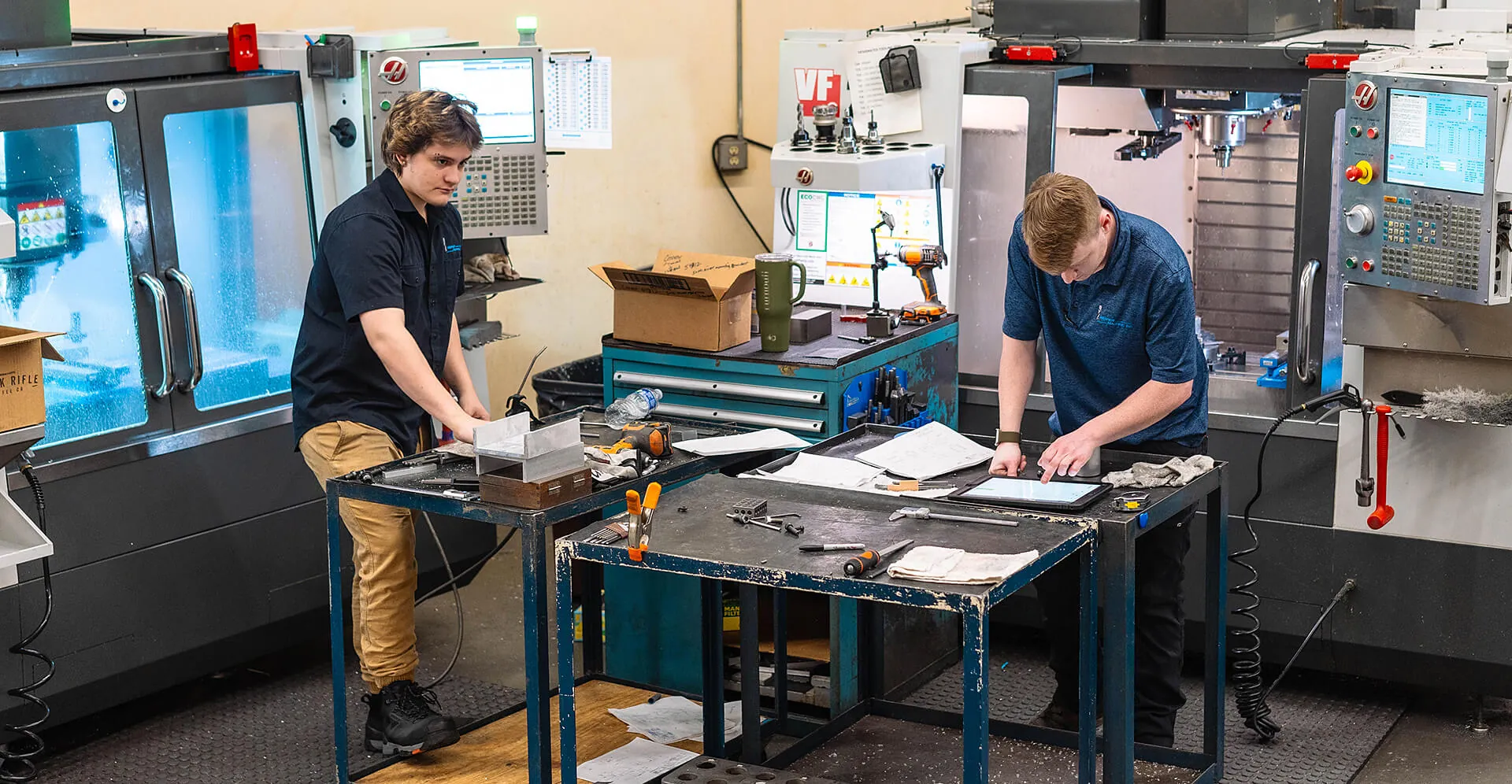
I've seen shops go from spreadsheets and whiteboards to real-time MRP and discover they can take on significantly more work without adding headcount. That's the kind of efficiency gain that makes domestic manufacturing cost-competitive — and it has nothing to do with tariff rates.
You Don't Have to Build It Alone
Here's something the big companies need to hear: you don't need to build manufacturing capacity from scratch. That's a massive, slow, expensive undertaking. And frankly, it's the wrong approach.
The smarter play is to partner with your domestic supply chain. There are thousands of experienced job shops and contract manufacturers across this country who know how to make parts. They have the machines, the expertise, and the certifications.
What they need is the right contracts and the right digital infrastructure to scale.
OEMs and primes who treat their suppliers as real partners — sharing forecasts, co-investing in tooling, integrating systems — ramp up ten times faster than those trying to go it alone. I've seen it firsthand.
This is how reshoring actually works at scale. It's not one company building a mega-factory. It's a network of capable shops, connected by modern software, executing as a coordinated supply chain.
The shops that are ready — with real-time MRP, digital quality systems, and compliance certifications — are the ones winning the reshoring wave. The ones still running on paper and tribal knowledge are getting left behind.
The Strategic Bet
Here's how I think about it: whether tariffs are 10%, 25%, or 0% next year, the companies that invested in domestic capacity and automation are insulated either way.
If tariffs stay high, you're not paying them. If tariffs drop, you've still got shorter lead times, better quality, and full control over your IP. You win in both scenarios.
This isn't a bet on trade policy. It's a bet on operational excellence. And that bet pays off regardless of what happens in Washington.
The numbers speak for themselves: 244,000 reshoring and FDI jobs announced in 2024 alone. A 40% increase in manufacturing construction spending. This isn't a blip — it's a decade-long trend that's accelerating.
You control your costs. Your quality. Your lead times. Your IP. That's not a tariff play — that's a competitive advantage.
Conclusion
The Real Question
The question isn't whether tariffs will stick. Rates will change again — probably before this article gets old.
The question is whether you're building a manufacturing operation that doesn't need them to compete.
That's the bet worth making. And from where I sit, helping manufacturers make that transition every day, I can tell you — it's already paying off. Check out some of our manufacturer case studies to see the results firsthand.
If you're thinking about what this looks like for your operation — whether you're a shop looking to modernize or an OEM evaluating your supply chain — let's talk. StartProto helps manufacturers build the digital infrastructure that makes domestic production competitive.
Request a demo and see how we can help.

Unlock the potential of AI manufacturing
Blogs & Resources
Industry trends, manufacturing business tips, and more

Ready to get started?
We'll make it easy for you — pick the time that works best for you and we'll send an invite right to your calendar.